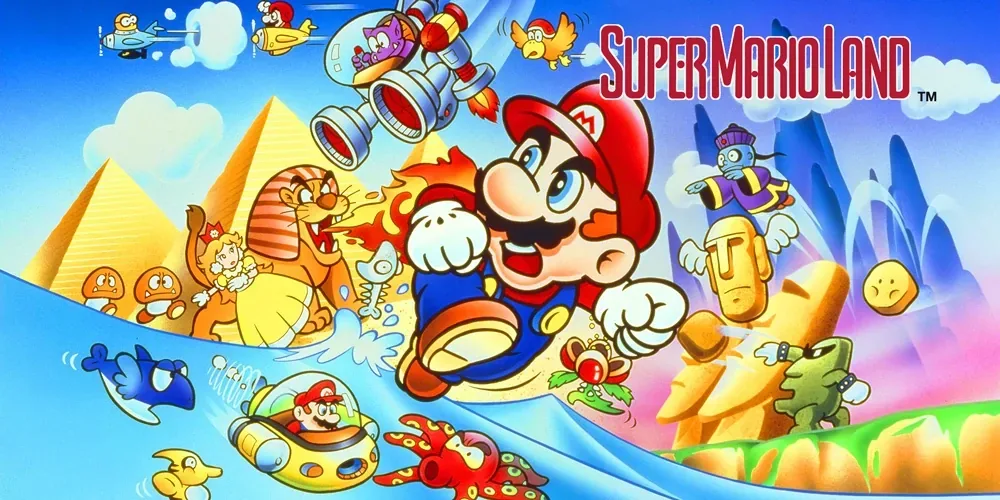
Super Mario Land is a side-scrolling platformer that Nintendo released in 1989 as a launch title for the original Game Boy. The team behind it worked under Gunpei Yokoi rather than the usual Mario crew led by Shigeru Miyamoto, which gives this entry a distinct flavor compared to its console siblings. Players guide Mario through the foreign kingdom of Sarasaland to rescue Princess Daisy from the alien menace Tatanga. The handheld limitations pushed the developers to shrink sprites, reshape enemies, and rework the iconic Mario formula for a tiny monochrome screen. Mushrooms still grant a power boost, fire flowers still toss projectiles, and koopa shells still bounce, yet many small twists set this adventure apart. Defeated turtles explode after a short delay instead of sliding harmlessly across the floor, forcing players to think differently about every encounter. The compact stages, faster pace, and quirky enemy roster turned this title into one of the strongest reasons to own the Game Boy at launch and helped it sell over 18 million copies worldwide.
Updated: Jun 22, 2026
Screenshots
0.06 MB · GB / GBC ROMs
External mirror link — Roms Portal hosts no ROM files. Always verify a file's checksum against the known-good hash before use.
Specifications
| Platform | GB / GBC ROMs |
|---|---|
| Genre | Action |
| File Size | 0.06 MB |
| Release Year | 1989 |
| Developer | Nintendo R&D1 |
| Updated | Jun 22, 2026 |
Overview
Super Mario Land is a side-scrolling platformer that Nintendo released in 1989 as a launch title for the original Game Boy. The team behind it worked under Gunpei Yokoi rather than the usual Mario crew led by Shigeru Miyamoto, which gives this entry a distinct flavor compared to its console siblings. Players guide Mario through the foreign kingdom of Sarasaland to rescue Princess Daisy from the alien menace Tatanga. The handheld limitations pushed the developers to shrink sprites, reshape enemies, and rework the iconic Mario formula for a tiny monochrome screen. Mushrooms still grant a power boost, fire flowers still toss projectiles, and koopa shells still bounce, yet many small twists set this adventure apart. Defeated turtles explode after a short delay instead of sliding harmlessly across the floor, forcing players to think differently about every encounter. The compact stages, faster pace, and quirky enemy roster turned this title into one of the strongest reasons to own the Game Boy at launch and helped it sell over 18 million copies worldwide.
The game splits its action across four themed worlds called Birabuto, Muda, Easton, and Chai, each ending with a boss fight that demands a different approach. Two of those stages swap Mario's familiar foot patrol for vehicle sequences, putting players in the Marine Pop submarine for an underwater shoot up and the Sky Pop airplane for a sky-based blaster level. These shooter segments lift ideas from arcade classics and inject welcome variety into the platforming. A scoring system rewards careful play, since hitting the top of the flagpole at the end of a stage triggers a bonus mini-game where players can win extra lives or a fire flower upgrade. Hidden bonus rooms, warp zones, and a hard mode that opens after the credits give skilled players strong reasons to come back for repeat runs. Although the cartridge lacks a multiplayer mode, the tight controls, catchy chiptune soundtrack by Hirokazu Tanaka, and short bursts of action made the title a perfect fit for pocket play. It remains a charming and historic chapter of the Mario series.